-
Open
Fragments: May 27
 At the GOTO Conference in Copenhagen in 2025, Kent Beck and I spent some time on stage talking and answering questions from the audience - a format I refer to as “two old geezers on a park bench”. We talk about our experiences with LLM-augmented programming (at that point - October 2025), we show our frustration that things we’ve been saying for thirty years still need to be said, we say how anything like a manifesto reunion needs to be led by a younger generation, and opine on what junior developers should be focusing on in their career.
❄ ❄ ❄ ❄ ❄
Ian Johnson has written a series of posts about restructuring a gnarly codebase
The story follows a real Laravel + React codebase over ~3 months and ~258 commits from a legacy monoli…
( 6
min )
At the GOTO Conference in Copenhagen in 2025, Kent Beck and I spent some time on stage talking and answering questions from the audience - a format I refer to as “two old geezers on a park bench”. We talk about our experiences with LLM-augmented programming (at that point - October 2025), we show our frustration that things we’ve been saying for thirty years still need to be said, we say how anything like a manifesto reunion needs to be led by a younger generation, and opine on what junior developers should be focusing on in their career.
❄ ❄ ❄ ❄ ❄
Ian Johnson has written a series of posts about restructuring a gnarly codebase
The story follows a real Laravel + React codebase over ~3 months and ~258 commits from a legacy monoli…
( 6
min )
The test suite as a regression sensor
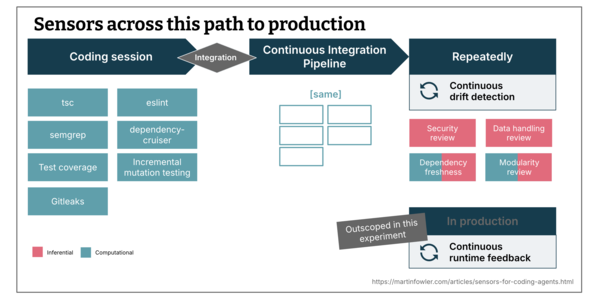 Birgitta Böckeler finishes her post on sensors for
coding agents by examining the role of a test suite as a regression
sensor, focusing on the role mutation testing can play.
more…
( 19
min )
Birgitta Böckeler finishes her post on sensors for
coding agents by examining the role of a test suite as a regression
sensor, focusing on the role mutation testing can play.
more…
( 19
min )
The VibeSec Reckoning
Vibe coding has significantly accelerated software prototyping but AI
agents frequently recommend insecure configurations, creating security
problems. Gautam Koul, Lucian Moss, Neil Drew-Lopez, and Daberechi
Ruth Edeokoh share their experience while building applications
for Thoughtworks's global marketing. They learned that to combat this we
need to write a security context file to guide the AI, be cautious with AI
permission requests, create a daily security intelligence feed, and
provide builders with a secure-by-default harness and templates.
more…
( 10
min )
-
Open
-
-
Open
Bliki: Vibe Coding
Vibe coding is building a software application by prompting an LLM, telling it
what to build, trying it out, prompting for changes - but without looking at
any of the code that the LLM generates. This technique can be used by people
without any knowledge of programming. However the resulting software often
shows problems with maintainability, correctness, and security - so is best
used for disposable software written for a limited audience.
The term was coined in February 2025 by Andrej Karpathy, an experienced
programmer, in a post on X:
There's a new kind of coding I call “vibe coding”, where you fully give
in to the vibes, embrace exponentials, and forget that the code even exists.
It's possible because the LLMs (e.g. Cursor Composer w Sonnet) are getting
too goo…
( 3
min )
-
Open
Netflix Tudum Architecture: from CQRS with Kafka to CQRS with RAW Hollow
No content preview
 Git worktrees have been around since 2015, but it wasn't until recently they became popular. Learn what they are, how to use them, and why you might.
The post What are git worktrees, and why should I use them? appeared first on The GitHub Blog.
( 12
min )
Git worktrees have been around since 2015, but it wasn't until recently they became popular. Learn what they are, how to use them, and why you might.
The post What are git worktrees, and why should I use them? appeared first on The GitHub Blog.
( 12
min )